



You're not hurt, exactly. Nothing happened. But somewhere along the way, the bra became the hardest part of getting dressed. The clasp takes longer than it used to. Your shoulders complain when you reach back. Some mornings you skip it altogether.
If any of that sounds familiar, it's worth asking whether an adaptive bra would make your morning easier.
When Getting Dressed Starts Taking Longer Than It Should
A bra you used to fasten without thinking can quietly turn into a ten-minute job. One customer told us hers had come to take 45 minutes, between the pulling, stretching, and twisting it took to hook everything into place and the pain that followed.
That slow creep is easy to explain away. You blame a bad night's sleep or a stiff morning. But when the same simple task keeps costing you more time and more discomfort, the task isn't the problem. The bra is.
The Signs Worth Paying Attention To
A few patterns tend to show up when a regular bra has stopped working for your body. The most common one is the back clasp: you can't line up the hooks behind your back anymore, or it takes several tries.
Reaching overhead to pull a bra on might feel difficult, or impossible on a bad day. Your fingers may fumble the clasp on stiff or swollen mornings, or drop it entirely.
Maybe you've started skipping the bra when your hands aren't cooperating. Maybe you've begun asking a partner or your daughter for help with something you used to do alone.

Or you're dressing around something specific now, like arthritis in your hands, a shoulder that's healing from surgery, or a stroke.
Any one of these is reason enough to look at a different kind of bra. None of them mean something is wrong with you. They mean a back-hook, overhead bra was built for a body that moves differently than yours does today.
A note on pain: if fastening your bra has started hurting in a new way, not just frustrating, but genuinely painful, that's worth mentioning to your doctor. An adaptive bra can take the physical effort out of dressing, and many women find it removes a daily source of strain.
But pain that's new, persistent, or getting worse usually has a cause that's worth understanding, and that's something a healthcare provider is better placed to help with.
How an Adaptive Bra Is Different From a Regular One
An adaptive bra is built around the parts of dressing that get hard, instead of assuming you can reach, pinch, and twist.
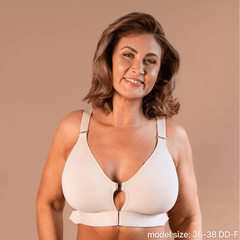
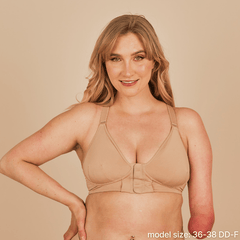
The biggest change is the closure: it sits in the front, where you can see it and reach it, so nothing happens behind your back. Many use Velcro, which peels open and closes without fine motor skills or a precise grip, so swollen or weak fingers aren't a barrier.
You don't need a diagnosis to benefit from that. Shoulders stiffen with age. Grip changes. Backs stop cooperating. A front closure just removes a contortion that was never necessary in the first place.
The straps adjust from the front, and there's no underwire pressing into a tender ribcage. That's what adaptive bras are designed for: keeping the support and losing the steps that hurt.
The Arthritis Foundation even recommends Velcro fasteners for dressing when hands are affected. Pull on a soft front-closing bra, fasten it where you can see, and most of the daily struggle disappears.

What Changes When You Switch
The first thing most women notice is time. Getting dressed stops eating the morning. The Easy-On Mobility Bra® is built for exactly this: a soft, wireless, front-closing bra with a Velcro closure that opens from the front in several ways, depending on what your body can do that day.
Mirna, who has fibromyalgia and CRPS, said she no longer hurts every time she puts a bra on. Another customer described the quiet relief of getting dressed for a medical appointment on her own, after a stretch when she'd felt real fear about undressing somewhere with no one there to help.
That's the part that matters more than the bra itself: doing a small, ordinary thing on your own schedule. If the signs above sound like your mornings, it may simply be time to try one.