



How Your Body Changes, and Why Your Old Bra Doesn't Fit Anymore
What actually shifts in breast tissue after 50
Skin loses collagen and elasticity over time, and the ligaments that support breast tissue weaken gradually. Research published in Maturitas on breast changes with aging found that 80% of women notice significant changes in their breasts with aging, including changes in firmness, volume, and shape.
Hormonal shifts around perimenopause and menopause accelerate these changes. The result: a bra that fit well at 45 may feel uncomfortable, unsupportive, or simply wrong by 60.
Why your size probably needs revisiting
Most women wear the same bra size for decades. That's rarely accurate. Weight changes, muscle loss or gain, and postural shifts, common effects of bone and muscle changes over time, all affect how a bra fits.
If your straps dig in, your band rides up, or your cups gape or overflow, the bra isn't working. And buying the same size again won't fix it.
Springrose's free bra size quiz for women with limited mobility walks you through it without a tape measure. You can also read how to find your bra size at home for the full rundown.
The features that matter most now
Bra priorities shift with age. The Maturitas study found the top concerns for mature women are: comfort, the ability to stay in place, optimal fit, support, and strap design. Features like wider straps, softer fabrics, and easier closures move from nice-to-have to essential.
What to Look For in a Bra for Older Women

Wireless vs. underwire
Underwire provides structure, but it comes with tradeoffs: it can dig into the ribcage, restrict circulation, and become genuinely uncomfortable over a long day, especially as breast tissue softens and sits differently.
A well-designed wireless bra can provide real support without those pressure points. Not all wireless bras are supportive. Wide bands, structured cups, and seam placement that lifts from below rather than flattening from the front all matter.
Strap width and shoulder comfort
Thin straps concentrate weight on a small area. Wider straps distribute it more evenly, reducing grooves, shoulder pain, and the cumulative discomfort that builds over a full day. For older women with softer skin or any shoulder sensitivity, strap width is one of the fastest improvements a new bra can make.
Front closures vs. back closures
Reaching behind your back gets harder over time. Shoulder and elbow range of motion decreases with age, and conditions like arthritis, frozen shoulder, or rotator cuff injury can make a standard back clasp genuinely painful.
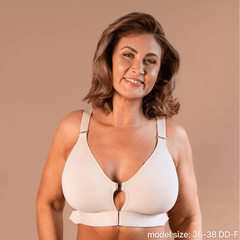
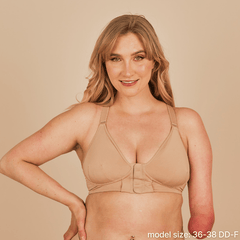
A front-closing bra removes that problem entirely: you fasten it where you can see it, with both hands working in front of you.
If Arthritis or Limited Hand Mobility Is a Factor
Why clasps get harder
Small hooks require pinching, precision, and coordination. For hands affected by arthritis, reduced grip strength, or limited fine motor control, those demands cause real pain.
Traditional hook-and-eye closures, even when placed at the front, still require enough dexterity to align two small parts under tension. If that's your reality, the closure type matters as much as the bra itself.
Velcro vs. magnetic closures
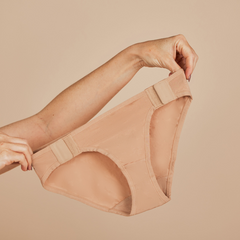
Velcro closures for adaptive bras require less dexterity, little to no precision, and some designs can be done one handed. Velcro is also safe for pacemakers, defibrillators, and other electronic medical implants, making it the default recommendation for anyone with a cardiac device.
Magnetic closures are gentler still — magnets engage with almost no force — but customers with pacemakers, ICDs, insulin pumps, or other electronic medical implants should consult their doctor before using a magnetic bra.
If grip is the primary issue, Velcro is usually the practical starting point. If even gentle gripping is difficult, magnetic closures may be the better fit. For more on how to choose, see finding the perfect bra for arthritis and limited hand mobility.
Some great options include Easy-On Mobility Bra® with a Velcro front closure and optional gripping rings, and the The Effortless Bra with a magnetic front closure and optional grip-assisting pockets.

If Support or Bust Size Is Your Main Priority
Good wireless support for a fuller bust
Wireless support gets a bad reputation because of poorly constructed styles. But a bra designed specifically for a fuller bust, with a wide underband, U-shaped back panel, and well-placed cups, can provide real lift without underwire.
The critical factor is cup range. Most adaptive and wireless bras top out at a D or DD cup, leaving women with larger busts to choose between support and ease of use.
The Goddess Lift Mobility Bra® is one of the only adaptive bras for women with limited mobility that reaches an H cup.
Full coverage for older women
Full-coverage cups contain and support breast tissue without compression or spillage. For women with softer or lower-sitting breast tissue, full coverage tends to look more comfortable under clothing and feel more secure throughout the day. Look for cups that extend to or slightly above the outer edge of the breast, not ones that cut across the middle.
For these women, The Effortless Bra might be the best all around fit.
If Comfort and Sensitive Skin Are Your Concerns
Tagless labels and seamless cups
Tags scratch. Seams dig in. Both are avoidable if you know to look. Tagless labels, printed directly on the fabric rather than sewn in, remove one friction point. Seamless or smooth cups remove another.
What fabric certification actually means
OEKO-TEX Standard 100 certification means the fabric has been independently tested for over 1000 harmful substances and found free of them.
For women with skin sensitivity, chemical sensitivities, or conditions that affect skin tolerance, common across chronic pain, autoimmune, and post-surgical situations, it's worth checking. All Springrose bra farbics are OEKO-TEX Standard 100 certified.