


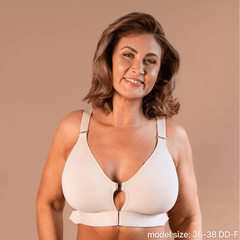
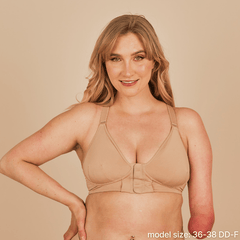
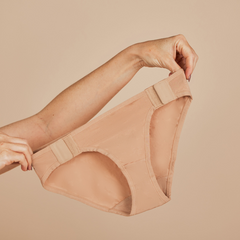
There are four real decisions to make when choosing an adaptive bra: how it closes, how you get into it, how it supports you, and how it fits. This guide walks through each one, then helps you find the right bra for your specific situation.
The 4 Decisions That Actually Matter

What kind of closure should an adaptive bra have?
An adaptive bra should have a closure that engages with the motion your hands and body can reliably do: Velcro for easy opening and closing, a magnet for snapping into place, or a snap button if you have most of your mobility intact.
The closure is always in the front (since the category exists to remove reaching behind your back).
- Velcro is best if you can press. The Velcro panel requires light pressure, so precise finger movements aren't required.
- Magnets are best if your grip is unreliable or your hands tire quickly — they snap together with almost no force.
- Snaps are for women who have full hand dexterity, strength, and mobility, but simply want an easier front closure than hook and eyes.
Watch for bras that put "adaptive" on the label but use a relocated hook-and-eye — small, fiddly, not actually any easier to manage. The closure should look obviously different from a regular bra hook.
How do I get into an adaptive bra without reaching behind my back?
Most adaptive bras are front closing. The best ones can be put on more than one way, so the bra you put on overhead in the morning is the same one you can step out of after a flare.
The Springrose Easy-On Mobility Bra®, in particular, is the most flexible adaptive bra in terms of how to put it on. You can step into it, pull it overhead, put it on one-handed, or slip it around your waist, whichever entry method works for your body.
Flexibility is the point. If your grip and energy vary, common with arthritis, EDS, fibromyalgia, or surgical recovery, multiple entry methods mean the bra works on good days and on hard days.
After shoulder surgery, most post-op customers use the step-in method: get the bra over your hips, pull it up with your good arm, secure the front. About thirty seconds once you've practiced it twice.
It also comes with optional gripping rings in case you have joint pain or limited dexterity and need some assistance.
What support level will I get in an adaptive bra?
Most adaptive bras offer medium or low support given that they are wireless front closure bras. The support comes from band engineering, cup construction, and strap width rather than a metal hoop.
This is fine for most people, but women with larger cups (starting at DD) might prefer more support from their adaptive bras.
The best in the category for fuller busts is the Goddess Lift Mobility Bra® — adaptive bra for larger busts, which comes in cup sizes DD–H. It has bigger cups, a U-shaped back, and optional racerback straps for added support.
How do I pick the right adaptive bra size without a tape measure?
The adaptive bra size quiz takes two minutes and asks questions about your current bra, no tape measure required!

Based on Your Situation
Surgery Recovery
What are the best adaptive bras for post-surgery comfort?
The best adaptive bras for post shoulder surgery comfort have a front closure with a one-handed dressing method, so you don't have to rotate the surgical arm, and a wireless construction so nothing presses on a healing area.
For shoulder surgery, look for a bra you can put on without lifting the operated arm, such as the Easy-On Mobility Bra® and the Goddess Lift Mobility Bra® (for bigger busts).
For mastectomy recovery, look for a bra with an easy Velcro or magnet front closure, without a wire and with a built-in mastectomy pocket. A good option is the Effortless Bra.
Many customers buy theirs before surgery so it's ready the day they come home.
What features should I look for in a post-surgical bra?
The features that matter are: a front closure, no underwire, soft non-irritating fabric, front-adjusting shoulder straps, and a built-in pocket if you need a prosthesis. Wide shoulder straps and a cushioned band also reduce pressure on a healing chest wall.
If you're in active recovery, check that the bra can be put on without rotating the surgical arm, whether one handed or by stepping in in the first six to twelve weeks.
Chronic Conditions
What are the best adaptive bras for arthritis and limited hand dexterity?
For bras for arthritis and limited hand dexterity, front closing bras with Velcro or magnets are the best adaptive bras, especially if they have optional gripping rings or finger pockets.
Some great options are the Easy-On Mobility Bra® and the magnetic Effortless Bra. These are assistive details that will help avoid needing to pinch, grab, or pull with arthritic hands.
If you are a bigger cup where support is crucial, such as a G or H, then the Goddess Lift Mobility Bra® will be a better fit.
People with rheumatoid arthritis tell us closing a bra is harder than putting it on, which is why the closure mechanism matters more than the dressing method. Plus, both Mobility Bras can be loosened from the front during a flare up.
What adaptive bras work for variable conditions like EDS or fibromyalgia?
The best bra for fibromyalgia needs to be adjustable during a flare and gentle on the skin. We recommend either of the Mobility Bras®, since they have adjustable Velcro front closures and soft fabric.
The best bra for EDS and hypermobility will be one that is flexible to avoid dislocations and subluxation, that can be taken off easily when energy reserves are low, and that will be sensitive on the skin. We recommend either the Mobility Bras® for versatility in dressing or the Effortless Bra for easy magnet front closures.
EDS, hypermobility, fibromyalgia, and POTS all bring day-to-day variability in grip, range, and pain tolerance.
What are the best adaptive bras for women with limited mobility?
The best adaptive bras for women with limited mobility offer multiple entry methods, a front closure you can engage one-handed, and have finger loops, gripping rings or finger pockets for weaker grip days.
The best on the market are the Springrose Easy-On Mobility Bra®, the Goddess Lift Mobility Bra (for larger busts), and the magnetic Effortless Magnetic Adaptive Bra.
They all have easy front closures, dual front-and-back closure for sizing adjustability, front adjusting shoulder straps, and a comfortable wireless design.

Life Stage & Caregiving
What's the best adaptive bra for stroke survivors and one-arm dressing?
The best adaptive bra for one-arm dressing has an easy Velcro or magnetic front closure. A few options include:
- The Easy-On Mobility Bra® with 4 one-handed dressing methods
- The Goddess Lift Mobility Bra® (for bigger busts) with 4 one-handed dressing methods
- The Effortless Magnetic Adaptive Bra with a front closing magnet (the least recommended, but doable)
What are the top features to look for in adaptive bras for seniors?
The top features in adaptive bras for seniors are: wide straps (¾" or wider) to reduce shoulder pressure, soft non-irritating fabric for thinning skin, a Velcro front closure for tactile feedback, and front-adjusting shoulder straps.
To understand the band size range, check inch measurements, not just the label number.
Velcro is usually preferred over magnets in this age range because it gives more tactile feedback, and it's safe for pacemakers, defibrillators, and other health implants.
However, magnets can be good for someone who just has some joint pain and limited mobility in their shoulder.
How can a caregiver help with putting on an adaptive bra?
The easiest way is using a magnetic front closing bra since it will be easier to put on like a vest and then close in the front.
For some individuals, such as those with dementia, they may even be able to manage it on their own, restoring some needed independence.
Before You Buy
Are adaptive bras covered by HSA/FSA?
Yes, at least Springrose® adaptive bras qualify for HSA and FSA coverage, and you can pay with your card at checkout.
Where can I buy adaptive bras online in the US?
Springrose® adaptive bras are available online in the US directly at Springrose.co
Exchanges and returns are easy if a size or style doesn't work the first time.