


Reaching behind your back to fasten a bra clasp is one of those morning tasks the bra industry designed for a 25-year-old. It assumes flexible shoulders, full hand strength, and the coordination to feel your way around something you can't see. For a lot of women, those assumptions stopped being accurate years ago.
A front clasp bra is built on a different premise: close it where you can see it, with both hands working in front of you.
But not all front closures work the same way, and the difference between a hook, a snap, Velcro, and a magnet matters more than most people expect.

What Is a Front Clasp Bra?
The basic concept
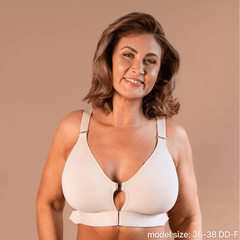
A front clasp bra, also called a front-closure bra, front fastening bra, or front hook bra, is a bra where the closure sits at the center front of the band rather than at the back.
Everything else about the bra works the same as a conventional style: cups, straps, and support structure are unchanged. The only difference is where and how you fasten it.
How it differs from a regular bra
In a standard bra, the closure sits between your shoulder blades. Fastening it requires reaching behind your back at an awkward angle and connecting two small metal parts by feel.
A front clasp bra removes that step entirely. You bring the two front panels together, visible, reachable, manageable, and connect them in front of you.
That shift is huge for women with arthritis, post-surgical arm restrictions, limited range of motion, or any condition affecting shoulder or hand function.
Types of Front Clasp Bras
Not all front closures are equally easy to use. The type of closure determines how much grip, precision, and hand strength you need to fasten it.
Hook-and-eye
The same hardware used on the back of traditional bras, moved to the front. You can see what you're doing, which helps, but you still need to align two small metal parts under tension. For women with limited hand dexterity or arthritic fingers, front hook-and-eye closures are easier than back clasps, but still require pinching and precision.
Snap clasp
A single plastic or metal snap that slides and clicks into place. Easier than hook-and-eye, fewer moving parts, less tension to manage. Still requires a reasonable grip and dexterity.
Velcro (hook-and-loop)
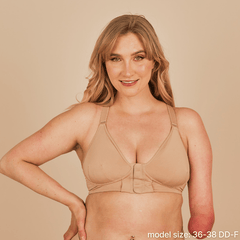
Velcro is the most forgiving closure for anyone with arthritic hands, reduced grip, or limited fine motor control. A wide panel that presses closed with a flat palm, and usually doesn't require a lot of grip strength to close.
It also sometimes allows for sizing adjustments depending on how tight or loose you set it.
Critically: Velcro closures are safe for pacemakers, defibrillators, insulin pumps, and other electronic medical implants, making them the recommended starting point for anyone with a cardiac device and joint pain.

Magnetic
Two magnets snap together with almost no force, you just bring the panels close and they engage. Some styles add hidden finger pockets or pulls to help guide the magnet into place without any grip at all.
It's the gentlest closure available. Important safety note: women with pacemakers, ICDs, defibrillators, or insulin pumps should consult their doctor before using a magnetic bra, as strong magnets can interfere with electronic medical implants.
For those people, Velcro is the safer choice.
Zipper
Found in some post-surgical and specialty recovery styles. For women with good hand dexterity, a zipper is a practical option, though it limits fit adjustability and is harder to loosen during the day.
For women with severe arthritis or significant joint pain, gripping and pulling the zipper tag may still be a challenge. More common in compression garments than everyday adaptive bras.
Why Front Clasp Bras Make a Real Difference for Limited Mobility
If arthritis makes small clasps painful
Arthritis changes more than grip, it raises the pain threshold for simple tasks. Aligning two metal hooks under tension, behind your back, with arthritic fingers, is genuinely painful for many women.
Velcro or magnetic front closures change the equation entirely: you're pressing, not pinching.
Colleen, who has joint problems that make conventional clasps difficult, describes it this way: "Velcro is so much easier than hook and eyes. It's now a piece of cake to put on." For bras designed specifically for arthritic hands, the closure type is the most important feature on the label.
If you're recovering from shoulder or arm surgery
After shoulder surgery, arm movement is restricted to protect the repair, reaching behind the back is often off-limits entirely. Front-clasp bras help in general, but the best adaptive options go further with multiple ways to get the bra on without raising the affected arm.
The Easy-On Mobility Bra® can be stepped into like shorts, pulled around the waist and rotated up, or put on like a vest, all without lifting the arm above shoulder height.
Joan, who was preparing for rotator cuff surgery, describes shopping for options: "Even front close bras like the one made by Bali is still basically a two-hand operation. This Springrose bra is a Godsend." For a full guide to bras after shoulder surgery, Springrose has a dedicated page.

If you dress with caregiver assistance
When someone else helps with dressing, a front clasp bra simplifies the process considerably. A front close plus an easy Velcro or magnetic closure means fewer steps, less repositioning, and more dignity for the person being dressed.
The Effortless Bra's magnetic front clasp with finger pockets is designed with caregiver-assisted dressing specifically in mind, including for women with dementia, where a simple, predictable routine matters.
What Else to Look For Beyond the Closure
Wireless support
Most front-clasp adaptive bras are wireless, so a wide underband and structured cups will help provide lift. Look for bras with a substantial band, not just thin elastic. The underband does the heavy lifting; the closure just keeps it in place.
Strap adjustability from the front
Back-adjusting straps require the same reach as a back clasp. Front-adjusting straps let you set the fit once, or fine-tune on a different-mobility day, without contorting.
It's a feature most conventional bras skip entirely, and one that makes a meaningful difference for anyone with restricted arm movement.
Fuller busts and front clasp bras
Finding a supportive front-clasp bra in larger cup sizes is harder than it should be. Most styles top out at a D or DD cup.
The Goddess Lift Mobility Bra® goes up to an H cup, with a U-shaped back panel and 1" wide straps built for real lift at that size. It's the only adaptive bra brand currently offering front-clasp options up to H, and worth knowing about if you've been settling for back-close styles by default.
